The Funding Landscape
Active transport infrastructure is receiving unprecedented government investment. But the funding must stretch across substantial infrastructure needs:
National Active Transport Fund
$100 million over 4 years (2025-2028)
For construction and upgrade of bicycle and walking paths across Australia
Active Transport Investment
$315 million over 4 years
Significant expansion and upgrade of state bike routes
Safe Cycling Network (estimated)
$400-600 million over 10 years
Infrastructure Victoria estimate for Melbourne and regional cities
The $100 million National Active Transport Fund sounds substantial, but it must be spread across many local and regional projects. Every cost-saving measure matters.
The Night Visibility Cost Challenge
Community expectations increasingly include after-dark safety. But traditional path lighting adds significant cost layers:
Traditional Electrical Lighting
- Poles and luminairesVaries by design
- Trenching and cablingVaries by site conditions
- Electrical connection feesVaries by utility
- Annual electricityOngoing operational cost
- Annual maintenanceOngoing maintenance cost
First km: Site-dependent
Ongoing: Ongoing costs
Photoluminescent Marking
- Material and applicationPremium marking rates
- No trenching required$0
- No electrical connection$0
- Annual electricity$0
- MaintenanceLower ongoing cost
First km: Lower infrastructure burden
Ongoing: Minimal energy costs
Benefits for Council Infrastructure
Dramatically Lower Capital Cost
No trenching, no poles, no electrical infrastructure. Application is a marking exercise, not a civil works project.
Zero Ongoing Electricity
Charges from sunlight, glows at night. No power connection, no electricity bills, no metering.
Dark-Sky Compliant
Soft ambient glow produces far less light than powered lighting. Suitable for paths through parks and sensitive areas when designed carefully.
Wildlife Friendly
Low-intensity marking can reduce wildlife disturbance compared to powered lighting, especially with careful placement.
Storm Resilient
No electrical components to fail during power outages. Paths remain visible when surrounding infrastructure goes dark.
10-Hour Night Visibility
Charges during daylight and glows through the night when fully charged.
Where Photoluminescent Makes Sense
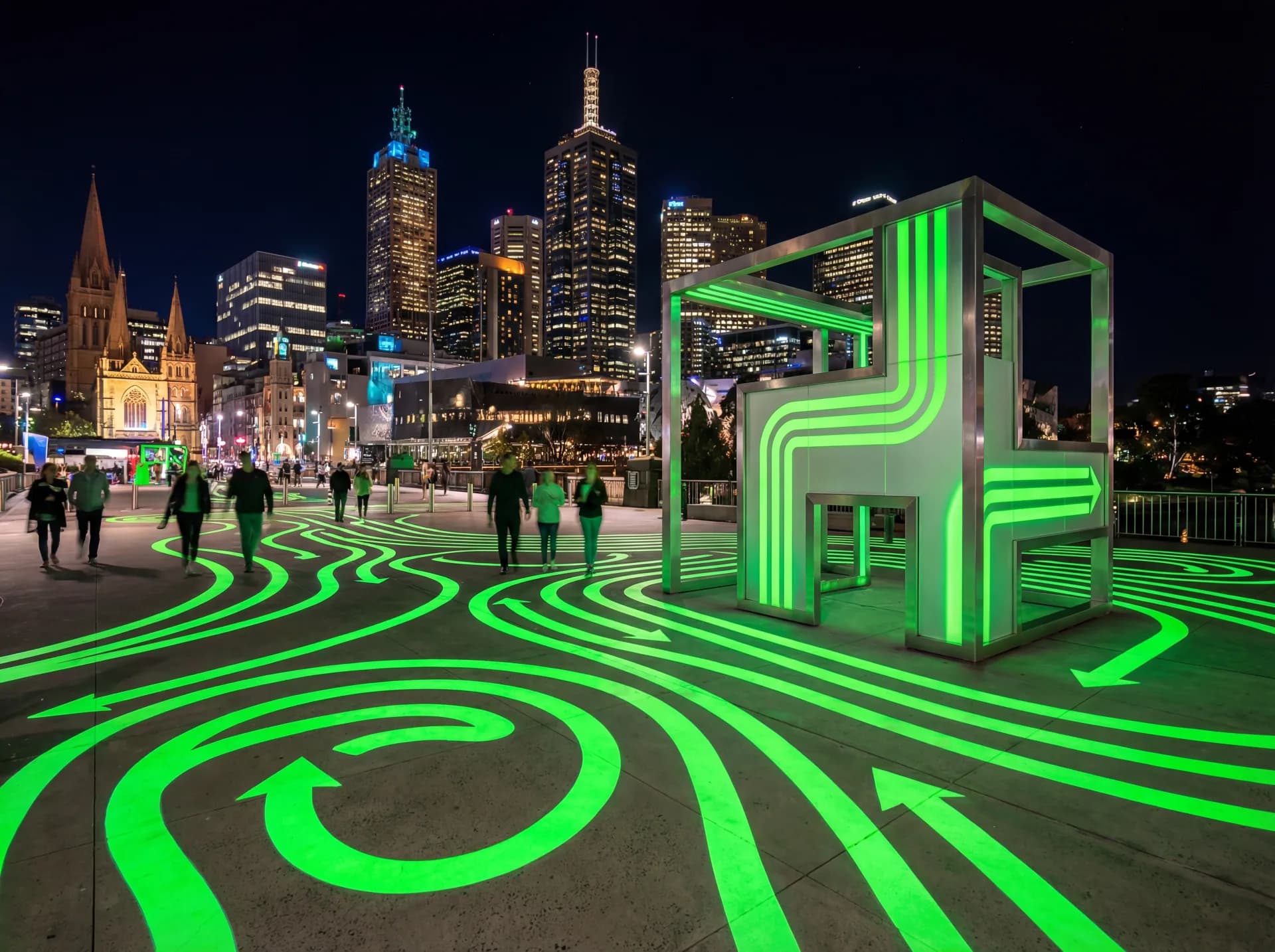
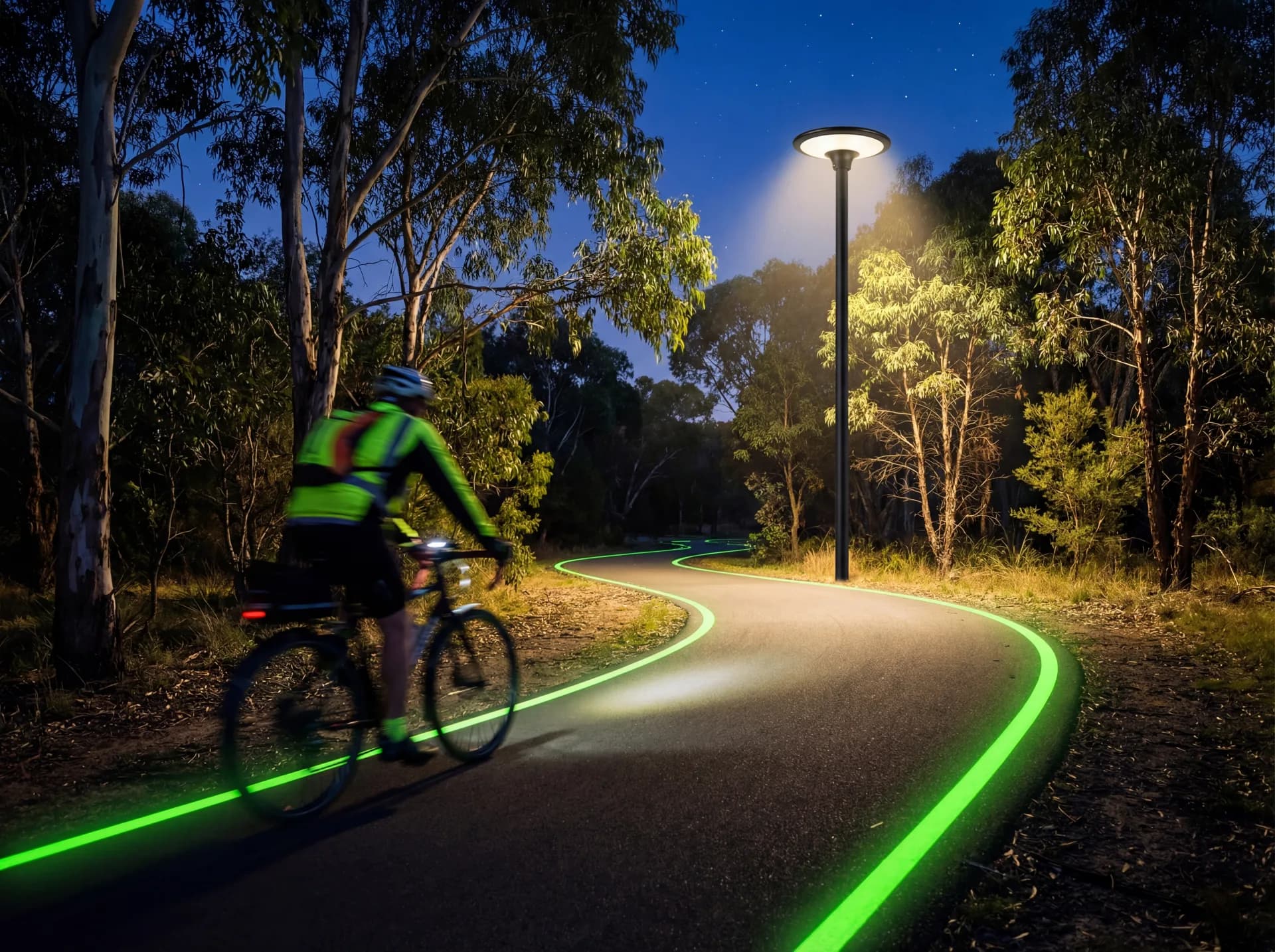
Greenway Through Park
Challenge: Path runs through natural area where poles and lighting would be visually intrusive and environmentally disruptive
Solution: Photoluminescent edge marking provides wayfinding without infrastructure impact
Remote Path Sections
Challenge: Shared path passes through areas distant from electrical grid, making connection costs prohibitive
Solution: No electrical infrastructure required — mark and walk away
Budget-Constrained Extensions
Challenge: Funding covers path construction but not lighting infrastructure
Solution: Photoluminescent marking stretches budget to cover more kilometres with night visibility
Flood-Prone Areas
Challenge: Coastal or riverside paths where electrical infrastructure faces flood and storm damage risk
Solution: No electrical components to damage; marking resurfaces as water recedes
Retrofit Existing Paths
Challenge: Established shared paths lack night visibility; retrofitting lighting is disruptive and expensive
Solution: Add photoluminescent edge marking with minimal path closure
Australian Deployment
Photoluminescent bike path marking is no longer theoretical for Australian councils:
Blacktown City Council
NSW — First Oceania LuminoKrom deployment (2024)
Photoluminescent edge marking on bike paths — Australia's first council installation of LuminoKrom technology.
Implementation Considerations
Not a Replacement for All Lighting
Photoluminescent marking provides wayfinding and edge definition, not illumination. It's ideal for paths but may need supplementation at high-activity nodes (intersections, seats, equipment).
Application Rate Matters
Minimum 900 g/m² is required for optimal glow duration. Under-application results in reduced visibility and shorter glow time.
Surface Condition
Like all road marking, surface preparation affects adhesion and longevity. New asphalt is ideal; older surfaces may need treatment.
Procurement Path
LuminoKrom is applied by line marking contractors. Councils can specify photoluminescent marking in tenders or approach contractors who have partnered with Tarsior.
For Council Officers: Getting Started
- 1Identify pilot locations — Look for path sections where lighting infrastructure is cost-prohibitive or environmentally problematic. Greenways through parks are ideal first projects.
- 2Request a site assessment — Contact Tarsior to discuss your specific path conditions and receive technical guidance on application requirements.
- 3Include in tender specifications — For upcoming path projects, consider specifying photoluminescent edge marking as an option or requirement for sections without electrical lighting.
- 4Plan community engagement — Photoluminescent paths generate significant community interest. Plan a dusk unveiling event to showcase the transformation from day to night visibility.